
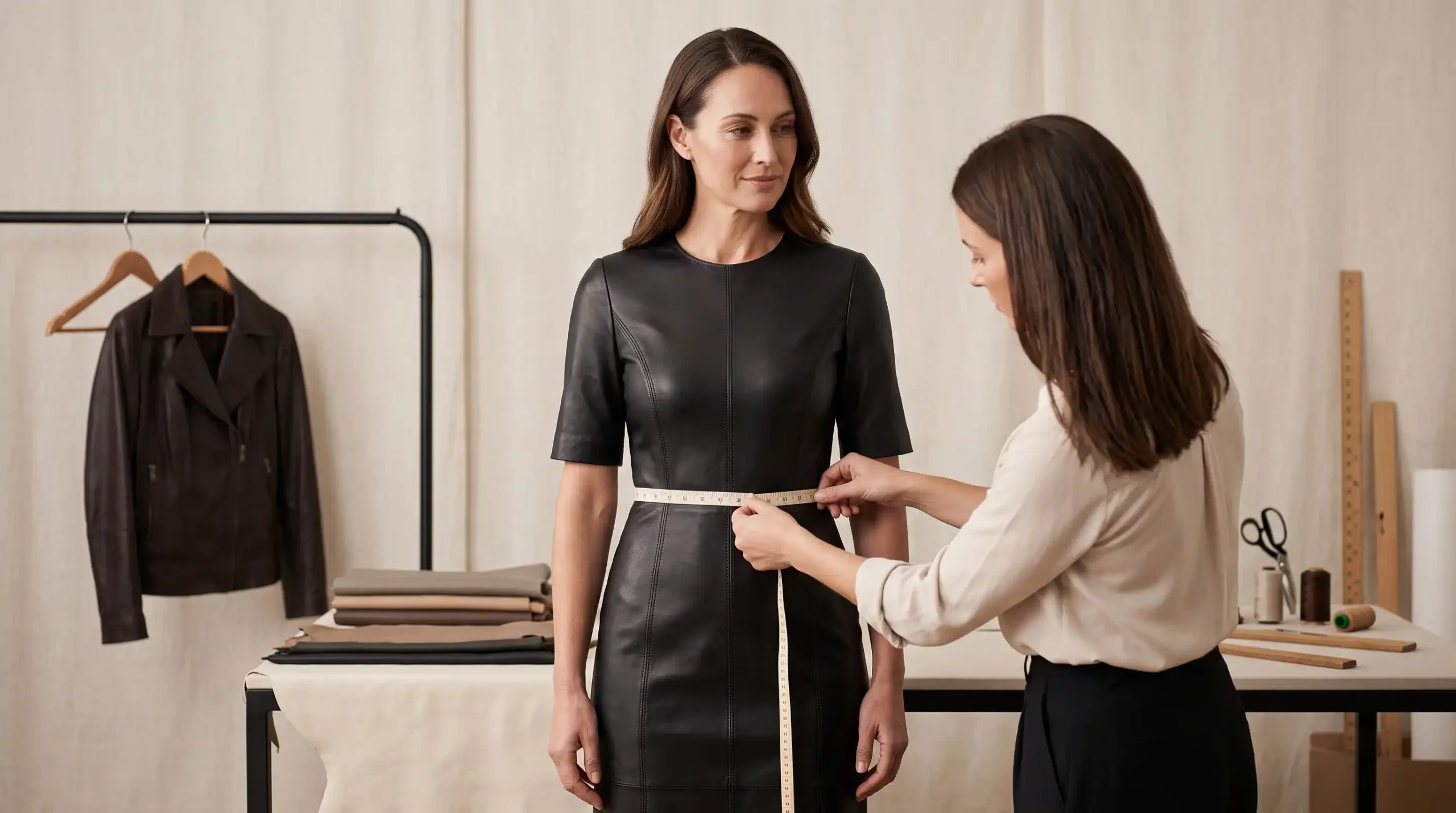
How to Measure Yourself for Custom Leather Clothing
You need a soft tape measure, close-fitting clothing and ideally another person. For most leather garments, bust, natural waist and hip are enough. Trousers also need rise, inseam and thigh; corsets and bodysuits need torso length; jackets need shoulder width and sleeve length.
Leather does not stretch the way woven fabric does. A cotton dress cut slightly small gives a little; a leather dress cut slightly small stays slightly small. That makes accurate measurements matter more here than in almost any other material — and it’s why we cut to measure rather than asking you to pick a size and hope.
This takes about ten minutes.
Before you start
Use a soft tape measure, not a builder’s tape. A length of string marked and held against a ruler works if you don’t have one.
Wear close-fitting clothing or underwear. Measuring over a jumper adds several centimetres in exactly the places that matter.
Ask someone to help if you can. Back measurements and shoulder width are difficult to take accurately on yourself, and self-measuring tends to produce a consistent small error because of how you have to hold your arms.
Keep the tape snug but not tight. It should sit against your body without compressing it. If it leaves a mark, it’s too tight — and a corset cut to a compressed measurement will not fit.
Stand normally. Don’t hold your breath, don’t pull your shoulders back, don’t suck in. Measure the body that will wear the garment.
Write everything down as you go, and note whether you’re using centimetres or inches. Mixing the two is the single most common error we see.
The core three
These cover dresses, skirts, tops, blazers and vests.
Bust — around the fullest part of your bust, tape level all the way round and parallel to the floor. Arms down at your sides. This is where a helper is genuinely useful, because lifting your arms to hold the tape changes the measurement.
Natural waist — the narrowest part of your torso, usually a few centimetres above your navel. To find it, bend sideways; the crease that forms is your natural waist. Do not use your jeans waistband, which usually sits lower.
Hip — the fullest part of your hips and seat, generally 18–20cm below your natural waist. Keep the tape parallel to the floor and your feet together.
For trousers, shorts and jumpsuits
These are the hardest garments to fit, and these three measurements are why.
Rise — from the crotch, up to where you want the waistband to sit. The easiest method is to measure a pair of trousers you already own and like: lay them flat, measure from the crotch seam straight up to the top of the waistband.
Inseam — from the crotch down the inside of the leg to where you want the hem. Again, easier from trousers you own than from your body. Tell us what shoe height you intend to wear them with.
Thigh — around the fullest part of your upper thigh, a few centimetres below the crotch.
Rise and inseam are the two measurements most often guessed, and they’re the two that decide whether the waistband sits at your waist and the hem falls where you want it. Neither can be corrected after cutting.
For corsets, bodysuits and jumpsuits
Underbust — directly beneath your bust, snug against the ribcage.
Torso length — for a corset, from the natural waist up to just under the bust at the front. For a bodysuit, from the top of your shoulder at the neck, down over the bust, through the crotch and back up to the same shoulder point.
Torso length is the measurement almost everybody skips, and it’s the one that determines whether a corset digs at the hip or a bodysuit pulls uncomfortably. If you’re ordering either, take it.
For jackets, blazers and coats
Shoulder width — across your upper back from the bony point of one shoulder to the other. This needs a helper. It’s also the single most important jacket measurement, because a shoulder seam in the wrong place cannot be disguised and cannot be altered in leather.
Sleeve length — from the shoulder point, down the outside of your arm to your wrist, with your arm slightly bent. Measuring with a straight arm gives you a sleeve that rides up.
Layering — tell us what you plan to wear underneath. A coat measured over a t-shirt and worn over a wool jumper will be tight. This is the most common outerwear sizing mistake and it’s completely avoidable.
The five most common mistakes
- Pulling the tape tight. Snug, not compressing. This alone accounts for most too-small orders.
- Measuring over bulky clothes. Close-fitting layers or underwear only.
- Using your dress size or jeans size instead of your body. Sizing varies wildly between brands. Your measurements don’t.
- Measuring the waist at the wrong height. Natural waist is the narrowest point, not where your jeans sit.
- Mixing centimetres and inches. Pick one and label it.
Send them to us first
We’ll check your measurements against the garment you’ve chosen before anything is cut, and tell you if something looks inconsistent — a hip measurement that doesn’t match the waist, or an inseam that seems short for the rise. It takes us a few minutes and it catches the errors that self-measuring produces.
Because every piece is cut to order specifically for you, it can’t be recut afterwards. The check is worth the five minutes.
[ Send your measurements → ]
Frequently asked questions
What measurements do I need for custom leather clothing? Bust, natural waist and hip cover most garments. Trousers and jumpsuits also need rise, inseam and thigh. Corsets and bodysuits need underbust and torso length. Jackets and coats need shoulder width and sleeve length.
Where is the natural waist? The narrowest part of your torso, usually a few centimetres above the navel. Bend sideways and the crease that forms marks it. It’s higher than most jeans waistbands.
Should I measure myself or get help? Get help if you can. Bust, shoulder width and torso length are all difficult to take accurately alone, because holding the tape changes your posture. Waist, hip and inseam are manageable on your own.
How tight should the tape measure be? Snug against your body without compressing it. If it leaves an indentation, it’s too tight. A garment cut to a compressed measurement will be too small.
What if my measurements are between sizes? That’s exactly why we cut to measure. You don’t need to choose between two sizes — send us your actual measurements and the garment is cut to them at no additional cost.