
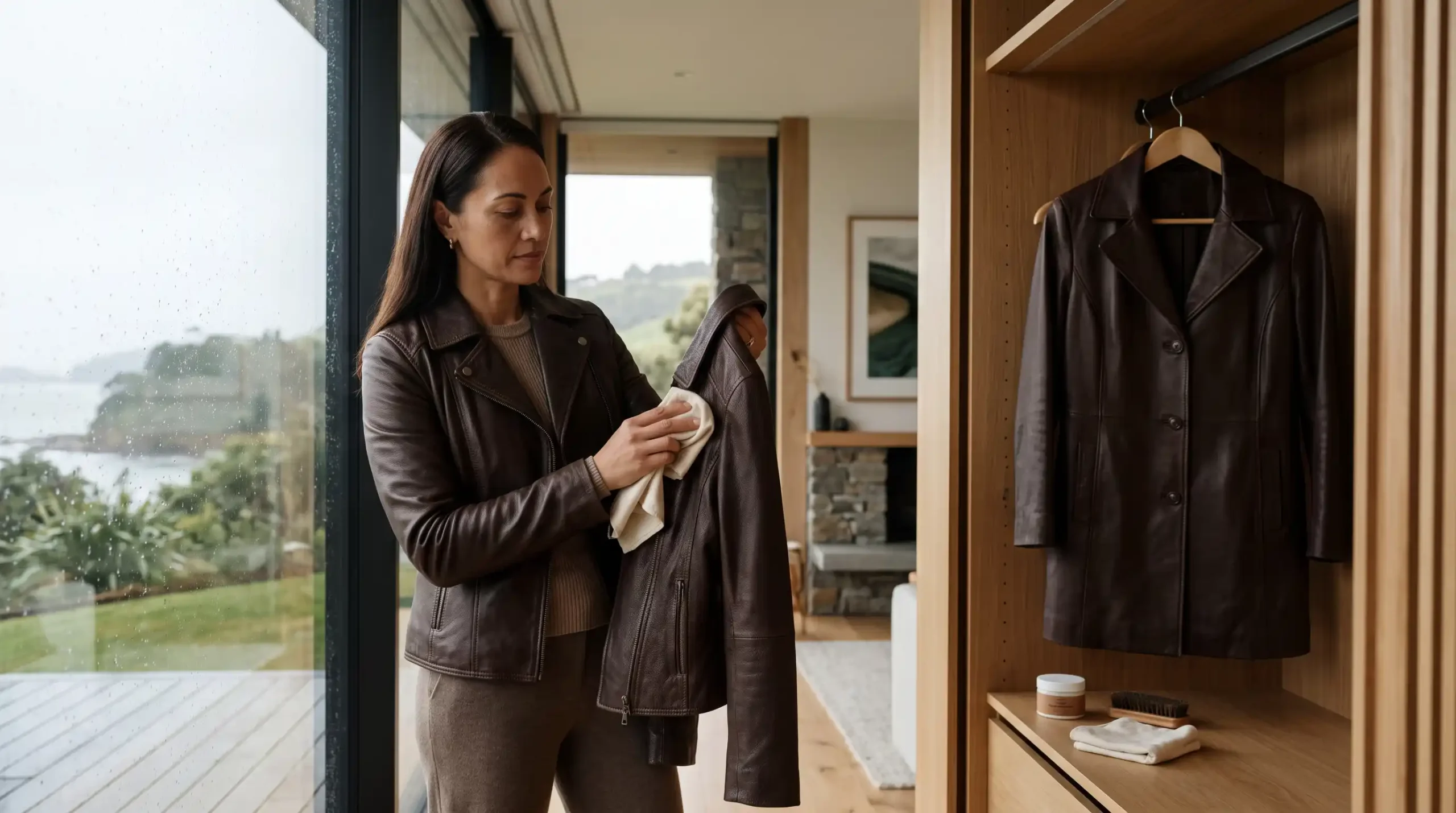
How to Care for Leather in New Zealand’s Climate
New Zealand’s leather care challenges are specific: some of the world’s strongest UV, coastal salt air across most of the country, and high indoor humidity in older housing. Store leather on wide hangers with airflow and never in plastic, keep it out of direct sunlight, and condition every six months rather than annually.
Most leather care advice online is written for northern-hemisphere conditions, and it under-prepares you for New Zealand. Three things here are genuinely harder on leather than in most of the countries that advice comes from.
Why New Zealand is harder on leather
The UV is extreme. New Zealand receives significantly stronger ultraviolet radiation than comparable latitudes in the northern hemisphere. It’s a combination of proximity to the Antarctic ozone thinning, unusually clear unpolluted air, and the Earth sitting closer to the sun during the southern summer. UV is what fades dye and dries the oils out of leather, and it will do it through a window.
Most of the country is coastal. No point in New Zealand is more than about 130 kilometres from the sea. Salt in the air is hygroscopic — it pulls moisture from the atmosphere and holds it against surfaces, including leather and, more importantly, metal hardware. Zips and buckles corrode faster in Auckland, Wellington and Napier than they do inland.
Homes are damp. New Zealand’s older housing stock is poorly insulated relative to its climate, and indoor humidity through winter is high in much of the country. Leather stored in a closed wardrobe in a damp Auckland house can develop mould within a single winter. This is the single most common way people lose a leather garment here, and it’s entirely preventable.
Storage
This matters more than cleaning, and it’s where most damage happens.
Use a wide padded hanger. Wire hangers put the entire weight of a leather garment onto two narrow points, and leather takes a permanent shoulder dent within weeks. Wide wooden or padded hangers spread the load.
Never store leather in plastic. Dry cleaning bags and vacuum bags trap moisture against the leather, which is precisely how mould starts. Leather needs to breathe. If you want a cover, use a cotton or canvas garment bag.
Leave air between garments. A tightly packed wardrobe has no airflow, and no airflow in a damp house means mould. Give each leather piece a few centimetres of clearance.
Keep it out of the light. Not just direct sun — a garment hanging in a bright room fades over a season. Store leather in a closed wardrobe rather than on an open rail near a window.
Never fold leather for storage. Creases in leather set permanently. Hang everything, including skirts and trousers, over a padded bar rather than folded in a drawer.
In a damp house, run air through the wardrobe. Open the doors regularly. If mould is already an issue in the room, a small dehumidifier or moisture absorber in the wardrobe is worth more than any leather product you can buy.
When leather gets wet
New Zealand rain is unavoidable, and light rain is not a problem if you handle it correctly.
- Blot, don’t rub. Press a dry cloth or towel against the leather to lift the water. Rubbing pushes moisture into the grain and can lift the finish.
- Dry it at room temperature. Hang it on a wide hanger away from any heat source. This is the step people get wrong — a radiator, heat pump vent, car heater or hairdryer will dry the leather far faster than the oils can redistribute, and it will crack.
- Let it dry completely before storing. Putting a damp leather garment back into a wardrobe in a New Zealand winter is how mould begins.
- Condition it afterwards. Water draws oil out as it evaporates. A soaked garment needs conditioning once it’s fully dry, regardless of when you last did it.
Salt water is different. If leather is splashed with sea water, wipe it with a cloth barely dampened in fresh water before drying. Salt left in leather keeps drawing moisture in and will eventually stiffen the fibres.
Cleaning
Keep it minimal. Most leather is damaged by over-cleaning rather than under-cleaning.
- Surface dust and marks — a barely damp cloth, then air dry. That handles the majority of everyday marks.
- Anything more — a proper leather cleaner made for garment leather. Test it somewhere hidden first, like an inside hem.
- Oil or grease — this is the one to act on immediately. Cover the mark with cornflour or talc, leave it several hours to draw the oil out, then brush it away gently. Do not use water on an oil mark.
- Never machine wash leather. Not on cold, not on delicate, not in a bag. The agitation and detergent will destroy the finish and the water will stiffen the fibres irreversibly.
- Mould — wipe it off outdoors with a dry cloth first so you’re not releasing spores indoors, then clean the area with a cloth dampened in a weak solution of white vinegar and water, then dry completely and condition. Then fix the storage problem, or it will come back.
Conditioning
Conditioning replaces the oils that UV, heat and water strip out. Without it, leather eventually cracks, and cracks cannot be repaired.
Condition every six months in New Zealand, rather than the twelve months usually recommended. If you live within a couple of kilometres of the coast, or the garment gets regular sun, make it every four.
The method is simple. Work a small amount of conditioner into the leather with a soft cloth in circular motions, leave it to absorb for twenty minutes or so, then buff off the excess with a clean cloth. Less product is better — over-conditioning leaves leather greasy and can darken it.
Match the product to the leather. Lambskin is thin and soft, and needs a light conditioner or a cream. Cowhide is thicker and takes a heavier balm. Suede and nubuck take neither — those need a brush and a dedicated suede protector, never a cream conditioner.
A seasonal routine
| When | Do this |
|---|---|
| Start of winter (May) | Condition everything. Check hardware for corrosion. Check the wardrobe for damp. |
| Through winter | Air the wardrobe regularly. Dry anything that gets wet, properly, before storing. |
| End of winter (September) | Clean and condition before storing outerwear for summer. Never store a dirty garment — marks set. |
| Summer | Keep leather out of direct sun. Condition anything worn regularly. |
Frequently asked questions
How often should leather be conditioned in New Zealand? Every six months for most of the country, and every four months if you live near the coast or the garment gets regular sun exposure. This is more frequent than the annual conditioning usually recommended, because New Zealand’s UV levels and salt air strip oils faster than most climates.
Can leather get mouldy in New Zealand? Yes, and it’s the most common way leather garments are damaged here. High indoor humidity in older housing combined with a closed, tightly packed wardrobe is enough. Prevent it with airflow, wide hangers, breathable covers rather than plastic, and a moisture absorber in damp rooms.
What happens if leather gets rained on? Nothing, if you blot it dry with a cloth and let it air dry at room temperature away from heat. The damage comes from drying it too fast with a heater or hairdryer, which cracks the leather, or from storing it while still damp, which causes mould.
Should leather be stored in a plastic bag? No. Plastic traps moisture against the leather and causes mould. Use a cotton or canvas garment bag, or leave the garment uncovered in a wardrobe with airflow.
Does sunlight damage leather? Yes. Ultraviolet radiation fades dye and dries the oils out of the hide, and New Zealand’s UV is stronger than most comparable latitudes. Leather fades through window glass, so store garments in a closed wardrobe rather than on an open rail in a bright room.